
Fireworks in a Glass


Most experiments utilize a jar for this experiment. I did not have a jar handy so I used a regular drinking glass. You will receive the same result as long as its in glass cylinder. 

What creates the fireworks display?

I will not get too technical (science isn't my thing) but this is a simple density demonstration. The food coloring dissolves into the water but does not dissolve into the oil. The food coloring floats at the surface of the glass since the oil is less dense than the water. However, the colors will soon sink to the bottom since they are heavier than the oil. The firework display occurs as the colors dissolve into the water. Isn't it cool?

What you will need

  • water
  • oil
  • glass (drinking glass or mason jar)
  • small bowl
  • food coloring
  • fork


Experiment Directions

1. Fill your glass or jar 3/4 of the way full with warm water.


2. In a separate bowl, mix a 3 tablespoons of oil.


3. Choose 3-4 colors of food coloring. I used all four food colors. I added a few drops of each color (red, yellow, blue, green) into the bowl. 


4. Use a fork to mix the food coloring and oil together. Do this gently. 


5. Pour the food coloring mixture into the jar. 
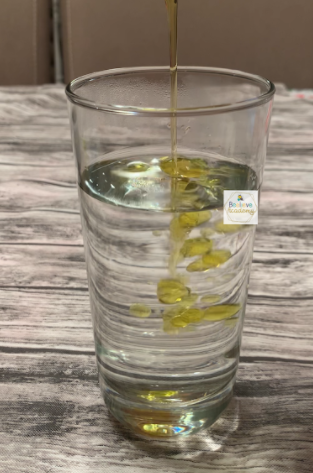


6. Boom! (not literal, of course) Watch the explosion! The colors will expand and move around the glass. 


Comments

Popular posts from this blog

Sensory Play Ideas

  What is Sensory Play and Why is it so Important? Sensory/Messy play occurs when your child is interacting with tactile items that stimulate any of their five senses ( hearing, touch, smell, taste, sight). Sensory play engages your child’s senses which helps them explore and learn about the world. Sensory play builds nerve connections in your child’s neural pathways which develops their cognitive thinking skills. Sensory play allows your child to use their imagination and develop their own creativity as well as self expression. Below you will find some sensory activities as well as recipes.  Adult supervision is always required for any activity. The sensory items below are suitable for children ages 2 and up. However, mamas always know best! Squishy Sensory Bags  Ingredients   1 Cup Flour 6 tablespoons water Food coloring Zip lock bags Duct tape (to secure bags)   Instructions   Mix until all blended  Put in ziploc and remove air bubbles by flattening...

Preschool Transition Tips and Songs

  What is a transition? A transition is a period where you are moving from one activity to another. Transitions can be a trying time and the hardest part of your day. But it doesn’t have to be. Transitions need to be consistent (scheduled) and as short as possible. Children often act out when they are waiting too long for the next activity to start. Minimize your transitions so that your children are not waiting longer than 5 minutes. Fill the time with a song appropriate for the activity- sing a song about food during lunch time, sing a clean up song after center time, sing a goodbye song at dismissal. Planning your transitions in advance will make your life and your child’s life a lot easier. Choose a song or phrase for each activity so your child will know what to expect. Singing the same song or playing a song for a particular activity will provide your child with stability and a sense of control. There are so many things out of a child’s control that they often resist transit...

70 Recycled items you can use every day in your homeschool

  I love to repurpose items because I enjoy creating new uses for things and it is budget friendly as well! Here is a list of 70 items you most likely have at home that you can use to enhance your homeschool experience. The items are divided into categories for dramatic or pretend play, math, literacy, crafts, storage, science, sensory, and block area. If you have any suggestions, feel free to add to this list! Happy homeschooling! Dramatic/Pretend Play Mommy/daddy shoes Wigs Hats Broom Plastic flowers Baby clothes Coupons Small kitchen appliances Food boxes/ cereal boxes/ juice containers Uniforms Dressy clothes Science Magnify glasses Pine cones Binoculars Plants Leaves Sensory bottles (recipe here) Rocks Seashells Homemade blocks Plastic cups PVC pieces Cardboard boxes Shoe boxes Cereal boxes Empty egg cartons Sensory materials Measuring cups (also math) Soap bottle containers Dyed rice/noodles Basters Pipette Scoops (also math) Strainers Whisks Baby formula scoops tongs Tweezer...